









The electric vehicle boom has completely reshaped China’s automotive market, pushing gasoline-powered cars, once the industry’s backbone, to the sidelines.
While the U.S. and Europe focus on countering China’s subsidized, affordable electric vehicles, Chinese gasoline-powered cars are increasingly appearing in Poland, South Africa, Uruguay, and other emerging markets. Fossil fuel vehicles accounted for 76% of China’s auto exports from 2020, with production expected to surpass 6.5 million units this year, up sharply from 1 million previously.
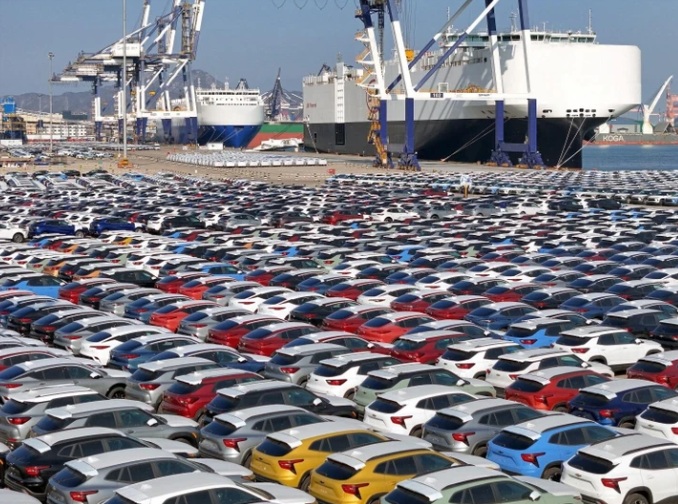
Cars awaiting export at a Chinese seaport. (Photo: Reuters)
This export surge stems from the same industrial policies and subsidies that propelled China to the forefront of the electric vehicle industry. Fierce domestic competition has drastically reduced demand for gasoline cars, forcing manufacturers to seek overseas markets.
Even excluding electric or plug-in hybrid vehicles, China remains the world’s largest auto exporter by volume, according to last year’s data.
State-owned giants like SAIC, BAIC, Dongfeng, and Changan drive much of this growth. After decades of relying on joint ventures with foreign firms, this model has weakened as BYD and other private electric vehicle makers gain market share. SAIC-GM’s China sales dropped from 1.4 million units in 2020 to 435,000 in 2024. Conversely, SAIC’s exports rose from 400,000 to over 1 million units during the same period. Dongfeng’s exports quadrupled to nearly 250,000 vehicles in 2023.
Chinese gasoline cars are particularly popular in Eastern Europe, Latin America, and Africa, where charging infrastructure remains limited. Despite Beijing’s global electric vehicle ambitions, many manufacturers use gasoline cars to establish their brands first.
Chery is China’s top exporter, with sales rising from 730,000 units in 2020 to 2.6 million in 2024, 80% of which are gasoline-powered. China’s top 10 exporters include five state-owned firms and two private companies, Geely and Great Wall Motor, all exporting more gasoline cars than electric vehicles.
Only Tesla and BYD export exclusively electric vehicles.
This year, China’s gasoline car exports are projected to exceed 4.3 million units, nearly two-thirds of total vehicle exports.
A Cutthroat Billion-Consumer Market
Leaders from Chery, Dongfeng, and FAW acknowledge that China’s fiercely competitive electric vehicle market makes exports essential for survival.
FAW’s design director, Giles Taylor, warns that some companies are “one product failure away” from bankruptcy, describing China’s auto industry as entering a “survival of the fittest” phase.
A Changan representative notes that gasoline cars are prioritized for export because they are “easier to customize for local markets and sell.”
.jpg)
Inside a Chinese auto manufacturing plant. (Photo: SCMP)
The export wave’s root cause lies in China’s years of government-backed factory construction. Automobility estimates the industry has excess capacity to produce 20 million gasoline cars annually, all redirected to foreign markets.
Consultancy AlixPartners predicts that by 2030, Chinese manufacturers could add 4 million annual exports, capturing 30% of the global auto market, particularly in South America, the Middle East, Africa, and Southeast Asia.
Local governments have exacerbated overcapacity by racing to build electric vehicle factories instead of converting existing gasoline car plants, even providing land and ready-made facilities to businesses. China can now produce 20 million electric and hybrid vehicles and 30 million gasoline cars annually, far exceeding demand.
Former Deputy Minister of Industry Su Bo warns that declining gasoline car sales are pushing the industry into a “survival crisis.” As a result, Chinese brands are accelerating their global expansion.
In Poland, since 2023, 33 Chinese brands have entered or announced plans to enter the market, primarily selling gasoline cars. A BAIC showroom manager in Warsaw notes that many Chinese SUVs are “so similar that customers struggle to tell them apart,” while distributor Jameel Motors describes the influx of Chinese cars as “crazy.”
Distributor Inchcape reports that most of their new contracts now come from Chinese manufacturers, who succeed by tailoring products to regional needs. Even in Australia, gasoline cars dominate Chery’s sales.
According to JATO Dynamics, Western automakers have weakened their position by focusing design, technology, and pricing on wealthy markets like the U.S., Europe, and Japan. In contrast, Chinese cars offer more features at similar or lower prices.
“Established brands have been complacent,” observes analyst Felipe Munoz.
The impact is most evident in Mexico, China’s largest auto market. This year, Chinese brands are expected to sell over 200,000 vehicles, capturing 14% market share, while Chevrolet faces sharp declines.
Mexico has raised import tariffs on Chinese cars from 20% to 50% to prevent China from using it as a “backdoor” to the U.S. Russia has also increased tariffs as Chinese cars claimed 64% market share in 2024, equivalent to 900,000 units. In South Africa, Chinese cars held nearly 16% market share in the first half of the year, mostly gasoline-powered.
In Chile and Uruguay, Chinese pickup trucks are becoming formidable competitors due to significantly lower prices than Japanese models. For example, the Dongfeng Rich 6 costs $21,490 compared to the Nissan Frontier’s $30,990.
While most Chinese brands rely on price advantages, not all follow this strategy. Jetour (a Chery subsidiary) plans to match international competitors’ prices when entering Europe in 2027. “We don’t want to engage in another price war,” said Yan Jun, Jetour International’s Vice President.
PV (VTCNews)
Electric Car “Frozen” by Water in Trunk: Repair Costs Rival Price of Used Toyota Corolla

A mere splash of water caused a Lucid electric vehicle to experience a critical malfunction, triggering a cascade of alerts, yet the manufacturer refuses to cover the repair costs.
VinFast Delivers 23,186 Electric Vehicles in November 2025
VinFast announced the delivery of 23,186 vehicles in November 2025, setting yet another record for monthly sales.
November 2025’s Top 10 Best-Selling Cars: Limo Green Takes the Lead in a Surprising Upset

According to the latest report from the Vietnam Automobile Manufacturers’ Association (VAMA), November saw the highest monthly sales volume in the market since the beginning of 2025.
Upcoming Discontinuations: SUV Models Ending Production by 2026

The SUV segment, long the shining star of the automotive market, is now entering a period of dramatic transformation.
VinFast Expands Tamil Nadu Plant, Targets Electric Bus and Motorcycle Production in India

VinFast and the Tamil Nadu state government have officially signed a Memorandum of Understanding (MOU) to allocate approximately 200 hectares of land in the SIPCOT Industrial Park, Thoothukudi city, for the expansion of the company’s existing facility.