


















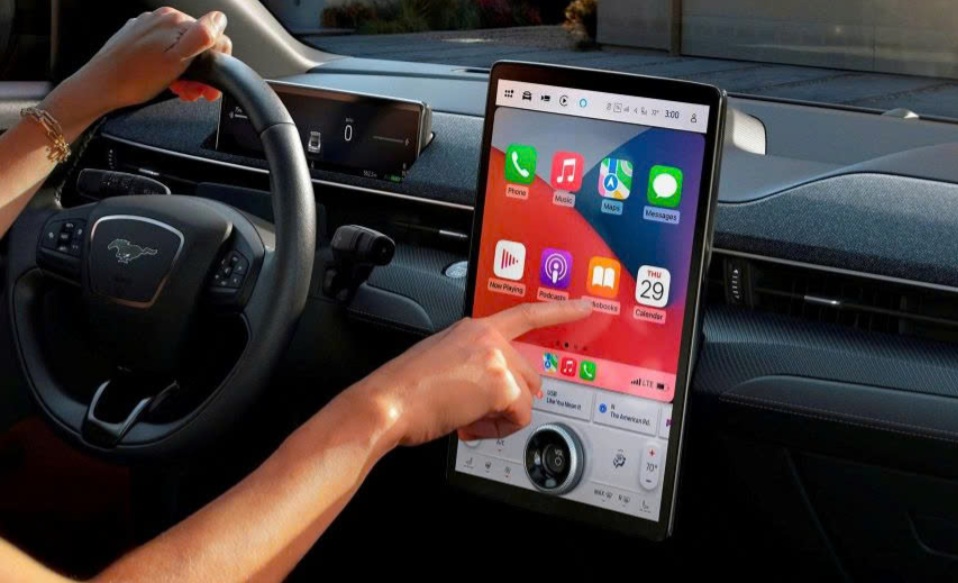
As car dashboards become increasingly cluttered with screens, posing a distraction risk for drivers, Ford has patented a groundbreaking technology called Dual View Display.
This innovation allows both the driver and front passenger to view the same screen but see entirely different content, effectively balancing entertainment needs with safety requirements.
Automakers are continually expanding the size and number of screens in new vehicle models. However, passengers watching movies or entertainment on the central screen often forces manufacturers to restrict or block the driver’s view, compromising the experience for both parties. Ford’s new patent directly addresses this issue.
According to the description, Dual View Display uses a single screen capable of displaying two distinct contents depending on the viewing angle. The driver can monitor essential driving information like navigation maps and vehicle data, while the passenger enjoys videos or entertainment without distracting the driver. The key difference lies in the system’s ability to generate two independent display streams rather than simply blocking one side’s view.
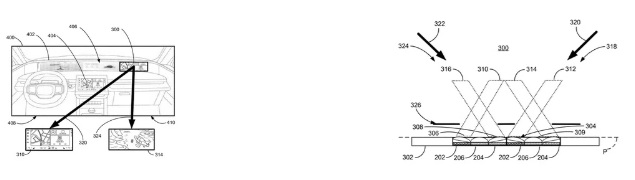
The screen is divided into separate LED zones, each corresponding to a specific viewing angle for the driver or passenger. Each LED zone is covered by a unique array of micro-lenses that direct light to the correct viewer. By controlling each LED independently, two completely different images can be displayed on the same screen surface.
A critical component enabling this system’s precision is a parallax barrier layer placed in front of the screen. While not entirely new, this technology was previously used in 3D TVs to ensure each eye receives a slightly different image, creating a depth effect. Ford has adapted this concept to separate content based on the viewer’s position in the car.
The patent also reveals that the screen is positioned high on the dashboard, similar to BMW’s iDrive Panoramic display. However, a significant challenge for Ford is ensuring the system functions accurately across the wide range of driver seat adjustments, from close to the steering wheel to far back.
Ford has not yet announced when or in which vehicle models Dual View Display will be implemented. Nevertheless, the patent filing indicates the American automaker’s serious commitment to finding a balance between dashboard digitalization and safety—a priority in the era of smart vehicles.
TH (Tuoitrethudo)
The Big Screen, Too Bright: The Unseen Hazard While Driving at Night
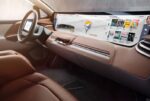
In the modern automotive era, large center infotainment screens have seemingly become a necessity.
The Future of Convenience in Cars

Manufacturers are continuously developing groundbreaking engines. In parallel, car utility technologies are also rapidly increasing. All of these aim to make drivers feel more comfortable and effortless.