



























The U.S. Army has officially unveiled the M1E3 Abrams, a groundbreaking evolution of the iconic main battle tank. This variant marks a historic shift, abandoning the traditional gas turbine engine in favor of a cutting-edge hybrid propulsion system.
The most significant transformation in this “behemoth” M1E3 lies in the replacement of the familiar Honeywell 1,500 horsepower gas turbine engine. Instead, the U.S. military has opted for the Caterpillar C13D diesel engine, widely used in heavy industrial equipment. This change simplifies maintenance, repairs, and parts supply on the battlefield, making it far more efficient than previous models.
The M1E3’s drivetrain has taken a giant leap forward with its hybrid system, integrating the SAPA gearbox and electric drive. This advanced configuration offers a unique tactical advantage, allowing the crew to operate the entire electronic system or move at low speeds using purely electric power. This capability ensures the tank can operate silently without engaging the internal combustion engine, providing a significant edge in stealth missions.
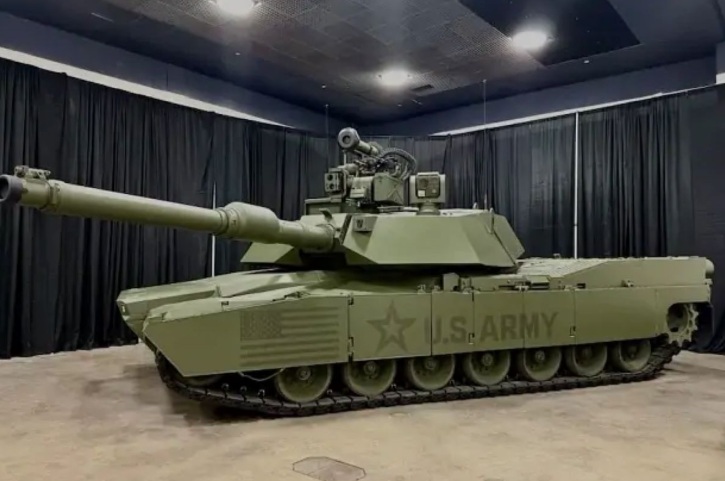
According to U.S. Army data, the hybrid system in the M1E3 improves fuel efficiency by up to 50% compared to its predecessors. Remarkably, the tank’s weight has been dramatically reduced from over 80 tons to approximately 60 tons. This 20-ton reduction enhances mobility across muddy terrains and facilitates crossing bridges with limited load capacities.
Inside the M1E3, the control cabin has been completely redesigned, featuring a racing-style steering wheel with customizable function keys tailored to specific missions. To counter modern threats, the tank is equipped with a 360-degree surveillance camera system and advanced acoustic sensors for early detection of drones—a primary danger on today’s battlefields.
Despite its formidable capabilities, the M1E3 remains a prototype and is undergoing further refinement. A key focus for U.S. military engineers is evaluating and selecting the optimal battery type for the tank’s high-voltage electrical system. The leading contenders are Lithium-ion and Lithium Iron Phosphate (LFP) batteries, both being rigorously tested to ensure maximum durability and safety in harsh combat conditions.
TH (Tuoitrethudo)